17/07/2013

How to Deal With Temptation

Are you any good at resisting temptation? All of us succumb to a little temptation now and then, but some people are blessed with more self-control than others. Temptation is about wanting something that you really want, often something that isn't right or good for you.
Resisting temptation is difficult because the object or subject of our desire is often all the more desirable because it's forbidden, out-of-reach, or hard to obtain. Sometimes temptation can turn into obsession if it's not possible to obtain the desired thing or person; other times, being able to give in to temptation leaves us feeling dissatisfied, guilty, or upset because we've done something we shouldn't have. This article discusses ways of dealing with temptation 
 
1.   Identify your own temptations. In the first place, a temptation is something you believe you must resist because to give in to it would be wrong according to your religious beliefs or moral code, bad for your health or well-being, or will cause disruptions in your relationships with other people. In the second place, giving in to it will cause you to feel bad after the initial pleasure, when it dawns on you that there is a high price to pay for the behavior or action you've given in to.

2.  Find what triggers your temptation. There are a lot of possibilities for triggers but you'll need to dig down to identify those specific to you.

3.  Work out your guiding values. For some people, faith provides a solid foundation of principles and morals to abide by; for others abiding by The Golden Rule, and seeking to actively be a constructive part of civil society forms a basis of values. Problems can often arise when you lack a firm foundation of values which can tempt you to live a life in which "anything goes", or leave you unable to discern what is right and wrong in any given situation. Ask yourself: Do I have a complete set of values I care enough about to abide by?

4.  Think about what it is you're succumbing to. Rather than blithely letting yourself fall into temptation, do the mental hard work of thinking it through to its final consequences. Few people tolerate pushing themselves through the entire process mentally because it's easier to make excuses up after the fact; thinking implies responsibility. This isn't a simple case of "I'd like chocolate, so I'm going to have some because I'm feeling really sad right now." This is thinking that requires you to identify what will happen if you give in.

 5.  Exercise your willpower. After thinking hard about the consequences, add your willpower to the equation. Expect exercising willpower to be difficult. Megan Oaten says that exercising willpower hurts when you first try but that, with practice, it becomes much easier. Start with something small and work your way up gradually.

 6.  Plan for temptation. Accept that you'll be tempted sometimes. Once you know your temptations and the triggers, work to manage them. That way, you can overcome them before they take hold. This is a positive way of tackling them rather than avoiding them (although, avoidance is discussed in the next step as another possibility.)

 7.  Don't enable temptation. This is the negative flipside of planning for temptation and it involves removing or avoiding the source of your temptation from your life if you're finding it impossible not to succumb.

 8.  Replace the temptation with distractions or pursuits of substance. Distracting yourself by doing something active is a good way of resisting temptation. Find other things to do to compensate for the lack or boredom that is confronting you. Get out and exercise, go for a back country hike, distract yourself from food by looking at something visually stunning such as a coffee table book, take up a new hobby, write a book on resisting temptation, plan a budget, wash the dog or the car, etc. Whatever you choose to do to distract yourself, throw yourself into it wholeheartedly.

 9.  Seek help. This is an often overlooked solution when bound up in thinking this is purely your own battle. Reaching out to other people to help you resist a temptation can be a very powerful solution, providing that they're understanding, caring, and prepared to help. People on whom you might be able to rely include parents, family members, friends, teachers, counselors, your doctor, your minister of faith, financial or budget experts, etc

 10.  Reward yourself for not giving in to temptation. Whenever you overcome adversity, you deserve a break. Do something that's good, fun, and healing for you and perhaps for those around you who might have been impacted if you'd given in. Take the family out to dinner, take your boyfriend hiking, watch a marathon of your favorite movies, spend time relaxing with someone you love, reconnecting.

Egypt's interim cabinet sworn in

 Cabinet swearing-in ceremony in CairoEgypt's interim president has sworn in the first Cabinet since the military ousted the Islamist president, giving members of the country's liberal movements key positions.

Students invent award-winning soap to tackle malaria

Moctar Dembele and Gerard Niyondiko are the creators of Fasoap, a soap designed to help tackle malaria.Your head is pounding, burning with raging fever, your aching bones feeling like they weigh a ton. Covered in profuse sweating, your exhausted body shivers with teeth-chattering chills.
For anyone who's suffered through severe bouts of malaria, this is the nauseating roller coaster the disease typically wreaks on its victims.
But now an award-winning innovation by two students in Burkina Faso could help reduce the devastating impact of the life-threatening disease, which is caused by parasites that are spread to humans through the bites of infected mosquitoes.
Moctar Dembele, who is from Burkina Faso, and Gerard Niyondiko, from Burundi, have used locally sourced herbs and natural ingredients to create a soap they say repels mosquitoes, in order to prevent malaria.

Flying doctor takes to the skies after sister's death

Ola Orekunrin (center) is the founder of Flying Doctors Nigeria, the first air ambulance service in West Africa.Ola Orekunrin was studying to become a doctor in the UK a few years ago when her younger sister fell seriously ill while traveling in Nigeria. The 12-year-old girl, who'd gone to the West African country on holiday with relatives, needed urgent care but the nearest hospital couldn't deal with her condition.
Orekunrin and her family immediately began looking for an air ambulance service to rapidly transport the girl, a sickle cell anemia sufferer, to a more suitable healthcare facility. They searched all across West Africa but were stunned to find out there was none in the whole region.
"The nearest one at the time was in South Africa," remembers Orekunrin. "They had a 12-hour activation time so by the time they were ready to activate, my sister was dead.
"It was really a devastating time for me and I started thinking about whether I should be in England talking about healthcare in Africa, or I should be in Africa dealing with healthcare and trying to do something about it."
Orekunrin did the latter. Motivated by the tragic death of her sister, the young doctor decided to leave behind a high-flying job in the UK to take to the Nigerian skies and address the vital issue of urgent healthcare in Africa's most populous country.

Teenager plans 'hacker school' to help Africa build next Google

Martha Chumo, aged 19, is on a mission to create a school for developers in Nairobi, the capital of Kenya. Martha Chumo, a 19-year-old self-taught programmer, was supposed to be in New York right now, honing her coding skills and mastering cutting-edge technologies in the company of fellow software enthusiasts.
Instead, she's thousands of miles away, in her hometown of Nairobi, Kenya.
A few months ago, Chumo was accepted into the summer intake of Hacker School, a U.S.-based "retreat for hackers," where budding programmers come together for three months to write code, learn new languages and share industry insights.
Whereas the programming boot camp was free to attend, Chumo still needed to find a way to cover her trip costs and buy a new laptop. Excited and determined, the young developer turned to online crowdsourcing platform Indiegogo for funds. She set a target of $4,200 and managed to raise nearly $5,800. All she needed then was a visa to travel to the United States.

Blind student learns to read Braille with lips

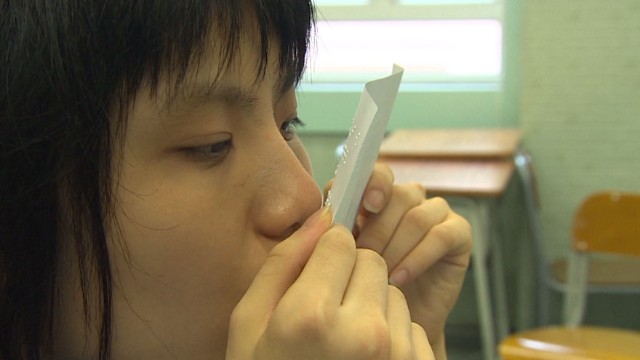
From a young age, Hong Kong student Tsang Tsz-Kwan has read Braille with her lips.
 Tsang Tsz-Kwan may look like an average student in Hong Kong with her standard-issue blue shift dress with a Chinese collar and sensible black shoes. But her ordinary appearance and shy manner mask a steely determination to triumph over tremendous odds.
She recently scored within the top 5% for nearly all her subjects in the city's college entrance examination -- despite being blind and severely hearing-impaired from a young age. She also lacks sensitivity in her fingertips, which denies her the ability to feel the raised dots of Braille characters.
Rather than admit defeat, the 20 year old found an alternative way to read Braille -- with her lips.
"In Primary 1 (the equivalent of Grade 1 in the United States), I noticed that she was always leaning forward," said Mee-Lin Chiu, a teacher at the Ebenezer School & Home for the Visually Impaired -- the only special needs school in Hong Kong dedicated to the blind.
"She told me it was because she could read more clearly with her lips than her hands."
This is the first I have heard of someone being successful using the lips.
Diane Wormsely, North Carolina Central University
Tsang herself admitted: "I know it's not a common approach and it sounds rather strange. Even I myself don't know how it came about," she added, calling it "miraculous."
In actual fact, the lips, tongue, and fingertips are particularly adept at spatial discrimination — they can perceive two points that are only 1-3 millimeters apart, according to the classic anatomy text, Field's Anatomy, Palpation and Surface Markings. In comparison, the legs or back of the hands can only detect two points with a separation of more than 50-100 millimeters.
While Tsang may not be the very first person to resort to lip-reading Braille, she appears to be a rare case. "This is the first I have heard of someone being successful using the lips," said Diane Wormsely, a professor at North Carolina Central University who specializes in education for the visually impaired. Chiu also said that Tsang was the only student at Ebenezer to have used their lips -- and is the sole case she is aware of in Hong Kong.
Lip-reading Braille is not without its challenges, however.
"Nobody could accept it in the beginning," Tsang said. "Even now, many people find it odd ... It's caused some embarrassment when I read in public places and in front of people that I don't have a close relationship with."
Nobody could accept it in the beginning...Even now, many people find it odd.
Tsang Tsz-Kwan
It also poses practical problems, as Braille books are typically large and heavy.
Nonetheless, Tsang said she is "grateful" to still have a way to learn about the world through the written word. Reading is one of her favorite past times -- a source of intellectual stimulation and psychological refuge.
She also believes she can transcend her disabilities through hard work, determination, and the willingness to push herself outside of her comfort zone.
"Without the courage to challenge myself, there is surely no possibility of success," she said.
At Ebenezer, her classes were comprised of only ten students, whose shared disability enabled them to easily build close friendships. All materials were prepared in Braille and teachers were specially trained to work with the blind.
But in Form 1 (the equivalent of Grade 7 in the United States), Tsang decided to leave the comfort of Ebenezer and move to a regular secondary school, wanting to immerse herself in a more authentic, mainstream environment. "I have to facilitate my adaptation to society when I finish my studies and have to enter the workplace," she said.
Her transition to the city's Ying Wa Girls' School was not always easy. Classes were much larger and teachers did not have specialized training to work with blind students. Tsang had to send all printed materials to Ebenezer or the Hong Kong Society for the Blind for transcription into Braille. Reading and writing took her twice the amount of time it did for her peers, she said.
She learned she had to be more independent and make a greater effort to express her feelings and needs with staff and students, who were welcoming but unaccustomed to dealing with a blind person.
Without the courage to challenge myself, there is surely no possibility of success.
Tsang Tsz-Kwan
One of her teachers, Kwong Ho-Ka, said that staff learned over time when to intervene to help her.
"If she needs something, she will let us know," Kwong said, adding that her fiercely independent student walked around the school campus unassisted, eschewing a walking stick and elevators and taking the stairs by herself.
Kwong, who clearly holds deep affection for her student, said that while Tsang was never bullied, social integration has been a gradual process.
"She has friends, but she's not part of some big group. For example, a gaggle of girls may be chatting about pop culture, but it can be difficult for her to enter the conversation. She may not recognize who is speaking in overlapping conversations and she lacks familiarity with pop culture."
Attending class with the same cohort of students over the past three years has helped a lot, Kwong said, and students have learned to make an effort to include Tsang in conversations.
Tsang said that she has made close friends. "I am grateful for their acceptance of me as a normal member of their social circle and throughout these years, they have given me a great deal of support and encouragement."
While her academic feats -- she scored 5**, the highest possible grade, for Chinese, English, and Liberal Studies, 5* for Chinese Literature and English Literature and 4 for Math — have won her much acclaim in Hong Kong, Tsang admits that she surprised herself.
"I was really astonished and excited when I heard that my results in some of the subjects were far from my expectations," she said. "I felt my hard work this year has finally paid off."
I'm going to treasure what I still have.
Tsang Tsz-Kwan
She hopes to study translation at university starting this fall to have a "balanced development in both Chinese and English."
"Whenever I come across some thought-provoking and touching books, I really wish I could translate them into different languages so as to share them with more readers," she added.
As she embarks on the new phase of her hard-won education, Tsang maintains matter-of-fact and philosophical. "The inconveniences and limitations (my impairments) bring will follow me my whole life ...and I must have the courage to face the facts...I'm going to treasure what I still have."
"I would like to encourage everyone to have the courage and perseverance to go through all the ups and downs in our lives because I know everyone has their own difficulties. But one thing is for sure: where there's a will, there's a way."

Deciding When Not To Decide

.

I’ve always thought a strong leader was a leader who could make a fast and informed decision about anything at anytime. I thought this kind of decision making would help you achieve a irreplaceable position in the organization.
And it might.
But it’s horrible for the developmental culture of your organization.
Making all of the decisions does nothing to help develop other leaders or make them feel like they’re an important part of the process and furthermore it continues to feed your self deception that you’re actually the smartest person in the room.
So these days when faced with a really important decision that needs to be made I’m learning to respond with a simple question.
What do you think?
Amazing how that one question…

1. develops ownership.
2. generates better ideas.
3. creates extra time for you to focus on what only you can focus on.

Don’t be afraid to let go of your need to control your own life. Decide not to decide.
I’m finding all kinds of uses for this principle at work, in my marriage and with my kids.
So let’s all say it out loud together….What do you think?
Anyone else struggle with a few control issues?

Why You’re Not as Tolerant as You Think!

Why You’re Not as Tolerant as You Think
Today's new view of tolerance says that telling someone their behavoir is sinful is, well, wrong. I’ve seen this repeated over and over again in the last few weeks/months/years by people who want to help the church shed its stuffy reputation. And I get it, in some ways. I think there are areas where the church needs to repent, times when the church has been hurtful, wrong and on the other side of important issues. Made up of humans, sinners, we’ve often, in our checkered 2,000 plus years of history, strayed from our gospel moorings.

However, it’s interesting, this discussion we are having in our culture. If you bend your ear to hear, what many people, most people, are saying is: You shouldn’t judge someone’s personal behavior (usually sexual preferences). You should respect their choices and give them the widest possible berth. They should be afforded all rights and privileges to practice the behavior they choose.
That’s what we are saying. For you to draw the line where you draw it, based on your belief system, is just plain wrong. This is what we are told.
The only problem is that we don’t actually believe this, do we?
For instance, it’s considered wrong now to tell someone that they are engaging in wrong behavior. If you follow an orthodox, biblical position on sexuality, for instance, you are usually labeled a bigot, insensitive and, well, ironically, wrong.
If you say that your basis for conduct is the infallible, inerrent Word of God, well then you are considered narrow, not really open-minded and, well, ironically, wrong.
If you declare that God is love, a love that expresses itself in right justice against sin, and if you declare that everyone is a sinner, you are considered judgmental and, ironically, wrong.
If you declare that God passionately pursued sinners by sending Jesus Christ, the only God-man, and that his death, burial and resurrection are the only way back to God, to eternal life and to spiritual wholeness, you are considered intolerant and, well, wrong.
But here’s the problem underlying all of this tolerance: It doesn’t work out. In order to definitively declare something wrong, you are acknowledging that there is a basis, somewhere, for actually deciding right and wrong.

13/07/2013

5 Bible Verses That Helped Me Get Closer To God


Revelation 21:8

But the fearful, and unbelieving, and the abominable, and murderers, and whoremongers, and sorcerers, and idolaters, and all liars, shall have their part in the lake which burneth with fire and brimstone: which is the second death.

John 14:15

If ye love me, keep my commandments.
Shortly after I was saved, God began to work on my heart to be a preacher of the Gospel of Jesus Christ. I was 16 years old and I had just been saved a few months. I wanted to know God’s plan for my life, but I didn’t want to admit that His plan was for me to preach His Word. After seeing another young man answer God’s call, I began to see myself preaching. With this overwhelming thought of standing and preaching, I was scared and did not  want to give up my plans for life.

2 Chronicles 7:14

If my people, which are called by my name, shall humble themselves, and pray, and seek my face, and turn from their wicked ways; then will I hear from heaven, and will forgive their sin, and will heal their land.

Matthew 6:5-7

And when thou prayest, thou shalt not be as the hypocrites are: for they love to pray standing in the synagogues and in the corners of the streets, that they may be seen of men. Verily I say unto you, They have their reward. But thou, when thou prayest, enter into thy closet, and when thou hast shut thy door, pray to thy Father which is in secret; and thy Father which seeth in secret shall reward thee openly. But when ye pray, use not vain repetitions, as the heathen do: for they think that they shall be heard for their much speaking.

Daniel 10:16-19

And, behold, one like the similitude of the sons of men touched my lips: then I opened my mouth, and spake, and said unto him that stood before me, O my lord, by the vision my sorrows are turned upon me, and I have retained no strength. For how can the servant of this my lord talk with this my lord? for as for me, straightway there remained no strength in me, neither is there breath left in me. Then there came again and touched me one like the appearance of a man, and he strengthened me, And said, O man greatly beloved, fear not: peace be unto thee, be strong, yea, be strong. And when he had spoken unto me, I was strengthened, and said, Let my lord speak; for thou hast strengthened me.

How to Feel Closer to God


1. If you are unfamiliar with God and don't know Him very well (ie: vaguely by name) then perhaps you should start by just locking yourself in your room. This will help you to feel that you are now alone with the Sustainer.

2.  Take a deep breath and try to clear your mind of all things that trouble you. Then, say aloud, "Hi, God. I saved this time for You. Will You please come and talk to me?" This may feel absurd at first but know that God truly listens and cares. Remember, "Ask and you shall receive." There is nothing wrong with asking for God to talk to you.

3.  Then, as you would speak to a friend or someone you really trust, unloosen your tongue and tell God all that bothers you. Or, tell Him something great that's just recently happened to you (ie: your team just won a game, someone you like asked you out, or you made a new friend). God listens and understands--always--so you won't have to feel silly.

4.  Another great way to feel closer to God is to get to know Him. What does He like? What does He dislike? What makes Him happy, sad or angry? What does He value? What does He think is foolishness? All these answers are in the book He gave to us through men He loved so we could know Him better. We call that book the Bible. He knows it very well. It has His promises in it that He makes for all of us. It has the story of Jesus (The Gospel of St John)and how He came to the earth and died on a cross, even though He didn't do anything wrong, so that we would be forgiven for our sins. It tells us what a "sin" is. As we learn about our Creator and our relationship with Him, we will get closer to Him.

5.  We can feel closer to God if we try to do the things He likes. If you came home from work and ignored your wife and brought home a girlfriend or two, you wouldn't have a very good relationship with her. You wouldn't feel very close to her even when you were alone with her. Relationship takes time and effort, and maybe a few flowers! God likes flowers too. He created them and He likes to hear about your enjoyment of them. In fact, God loves a thankful heart. If you don't know what else to say to God, tell Him how much you appreciate all the things He's made, all He's done for you, all He's given to you.

6.  Don't make promises to God that you can't keep. And if you fail on a promise, go back and make amends with Him. Maybe He will want you to make amends to others. Maybe not. Recognize, when you pray, what your feelings are so that you can understand Him better. Open your heart and be honest-He already knows whats in your heart. YOU need to see whats in there-and be honest about it. If you lie, you are only lying to yourself because He already knows the truth.

7.  Be aware that He can and will talk to you through your day to day life. He may talk into your heart during prayer ("Wow-I wouldn't have ever thought of that!") or throughout the day through other people who never knew what you said in prayer, or circumstances that are so very unusual. Also, He is usually more interested in answering the "Why?" instead of the "What?" or the "When?" Sometimes He answers "Yes", sometimes "No", sometimes "Not now".
 

Texas passes one of toughest anti-abortion laws in US


Abortion rights advocates fill the rotunda of the Texas state capitor as the senate prepared to vote

Texas politicians have given final approval to one of the US's toughest anti-abortion bills, but opponents are set to challenge the legisation in federal court.
More than a thousand pro-choice and anti-abortion demonstrators packed the state capitol in Austin late on Friday night as senators voted on legislation that has made Texas the focus of nationwide abortion-rights activism.
The senate passed House Bill 2 by 19 votes to 11 just before midnight local time. Texas governor Rick Perry is now due to sign it off.
Texas is one of several states that have sought to restrict access to abortions this year, but it has attracted the most attention due to the publicity surrounding Democratic state senator Wendy Davis's bid to block the bill with an almost 11-hour filibuster.
"The key will be what the courts will do," Sylvia Garcia, a Democratic senator for Houston and a former judge, said before the vote. "I think the Texas proposal is on a path to litigation, to being held unconstitutional. We'll have to wait for the courts to ultimately decide."
Last Monday a federal judge issued a ruling temporarily blocking the introduction of a new abortion law in Wisconsin. Like the Texas plans, the law calls for doctors who perform abortions to have admitting privileges at a nearby hospital. The Texas bill also insists that clinics upgrade to meet the standards of ambulatory surgical centres and bans abortions after 20 weeks.
Republicans blocked attempts by Democrats to dilute the measures on Friday, including an amendment that would have allowed exceptions to the 20-week limit for victims of incest or rape.
When Davis, her fellow Democrats and noisy protesters successfully stalled an attempted vote on the original bill on 25 June, Perry swiftly recalled lawmakers for a special session lasting up to 30 days to give the proposals another chance to pass.
Perry said on Fox News last Sunday that the shouting that scuppered the vote was "mob rule". During this session, which began last week, officials have been strictly enforcing a ban on what they consider to be disruptive conduct. But there was no silencing the crowds who gathered on all four floors of the capitol's huge rotunda on Friday for the climax of weeks of protests and rallies related to the bill, creating a heady, unruly atmosphere.
Many chanted slogans and songs and brandished banners. Some of the anti-abortion activists held up placards referencing the Bible. Those against the bill wore orange, and those who termed themselves "pro-life" dressed in blue.
By mid-afternoon the orange demonstrators heavily outnumbered the blues and the queue to enter the gallery stretched along a staircase and almost to the end of one wing of the statehouse, with hundreds standing for hours in the hope of seeing the proceedings. There was silence in the halls when Wendy Davis spoke shortly after 11.30pm. "Tens of thousands of Texans will not be able to make the long drive, sometimes hundreds of miles, to the closest clinic," she said. "We are about to take away from victims of rape and incest a chance to reclaim their lives."
Security was tight on Friday. The Texas department of public safety issued a press release saying it had confiscated containers suspected to contain urine, faeces, paint, confetti and glitter.
For a time, troopers even took away tampons on the basis that they could be used as missiles. Garcia believes that the publicity generated by the bill and the degree of dissent marks "a tipping point for women in Texas and across the country". The 62-year-old said the legislation is "part of an extreme agenda by radical right groups who would prefer to ban abortions around the country".
Democrats argue that the bill will force the closure of all but five of the state's 42 abortion clinics, resulting in a loss of access to other family-planning services they provide, such as advice and disease screening.
Opponents also claim it will force women in rural areas to travel vast distances or seek medical help from black-market sources. However, those in favour say that tightening regulations will help protect women if complications occur.
"It's not just about abortion, it's about women's healthcare and whether we allow government to chip away at constitutional rights," Garcia said. She accused Texas Republicans of putting women's safety at risk to satisfy personal political ambitions.
After the vote, Davis tweeted: "The fight for the future of Texas is just beginning." There are rumours that she may run for governor next year.

Featured post

10 Awesome Widgets to Try on Your Android Phone.

One way Android remains unique from other popular mobile phone operating systems is its embrace of app widgets. Widgets on your home screen...